


Tractography-based Predictors of Post-Stroke Aphasia: A Systematic Review
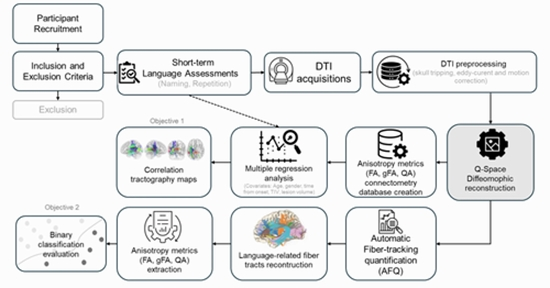
BACKGROUND: Post-stroke aphasia is a common and disabling consequence of ischemic stroke, substantially affecting communication and quality of life. Early identification of patients at risk is essential for prognosis and rehabilitation planning. Diffusion tractography has recently been employed to map white matter pathways implicated in language processing and to evaluate their predictive value for post-stroke aphasia.
PURPOSE: In this study we aimed to evaluate the prognostic value of diffusion tensor imaging characteristics of key white matter tracts.
DATA SOURCES: A systematic search was conducted in PubMed, Embase, and Scopus until April 2025.
STUDY SELECTION: Eligible studies applied diffusion MRI tractography to assess structural language pathways in patients with stroke and investigated their association with post-stroke aphasia occurrence or severity.
DATA ANALYSIS: Extracted data included study characteristics, tractography methodology, language assessment tools, and key imaging findings, including tract-specific diffusion metrics and tractography-derived measures. Due to data insufficiency, qualitative synthesis was conducted.
DATA SYNTHESIS: Twenty-one studies comprising 550 patients with post-stroke aphasia were included. Participants were predominantly older adults, with mean/median ages generally in the late 50s to early 70s. Baseline NIHSS values were commonly in the ∼5–14 range. The timing of diffusion/DTI acquisition varied substantially, spanning hyperacute/acute imaging, early subacute assessments, and later evaluations in the chronic phase. Studies identified left arcuate fasciculus (AF) integrity, fractional anisotropy (FA), axial diffusivity (AD), or reconstruction status, as the strongest single predictor of aphasia severity and recovery. Loss of AF reconstruction was associated with markedly lower follow-up AQ. Ventral-stream involvement added prognostic value in several studies. Right-hemisphere contributions were inconsistent, though higher callosal anisotropy predicted comprehension gains in one cohort. Overall, tract-specific microstructure improved prognostic models beyond lesion volume or NIHSS, accounting for an additional 12–29% of outcome variance in several multivariate analyses.


comment